History
In the past, the evaluation and treatment of patients' cognitive, emotional, and behavioral disorders relied primarily on the individual clinical judgment and intuition of each physician, lacking a standardized system. Subsequently, following the World Health Organization (WHO) conference on medical education in Southeast Asia held in 1956 at Bangsaen, Chonburi Province, a resolution was passed stating that a department of psychiatry should be established in the faculty of medicine at every university. This resolution led to the creation of designated psychiatrist positions to oversee this field in two medical universities in Thailand: the University of Medical Sciences at Siriraj Hospital and the Faculty of Medicine, Chulalongkorn University. One physician was selected from each institution to undergo training at Somdet Chao Phraya Hospital before returning to initiate psychiatric services at their respective universities. These physicians later pursued advanced studies and development abroad, sponsored by the Faculty of Medicine and the China Medical Board.
Upon returning from abroad, both physicians conducted medical instruction and provided clinical services for psychiatric patients, leading to the official establishment of the Psychiatry Unit under the Department of Medicine. Furthermore, the WHO advocated for the faculty member responsible for the psychiatry discipline to serve as a member of the Executive Board of the Faculty of Medicine, Chulalongkorn University. Later, the Psychiatry Unit was merged with the Neurology Unit.
The Department of Psychiatry, Faculty of Medicine, Chulalongkorn University, was officially established by the regulation of the Chulalongkorn University Council on June 27, 1973. It evolved from the Psychiatry Unit within the Department of Medicine, which had previously separated into the Division of Psychiatry in 1972 under the resolution of the National Education Council, before being approved for departmental status the following year. Associate Professor Pirom Sukhonthapirom na Phatthalung, M.D., served as the first Head of the Department.
Upon returning from abroad, both physicians conducted medical instruction and provided clinical services for psychiatric patients, leading to the official establishment of the Psychiatry Unit under the Department of Medicine. Furthermore, the WHO advocated for the faculty member responsible for the psychiatry discipline to serve as a member of the Executive Board of the Faculty of Medicine, Chulalongkorn University. Later, the Psychiatry Unit was merged with the Neurology Unit.
The Department of Psychiatry, Faculty of Medicine, Chulalongkorn University, was officially established by the regulation of the Chulalongkorn University Council on June 27, 1973. It evolved from the Psychiatry Unit within the Department of Medicine, which had previously separated into the Division of Psychiatry in 1972 under the resolution of the National Education Council, before being approved for departmental status the following year. Associate Professor Pirom Sukhonthapirom na Phatthalung, M.D., served as the first Head of the Department.
Infrastructure
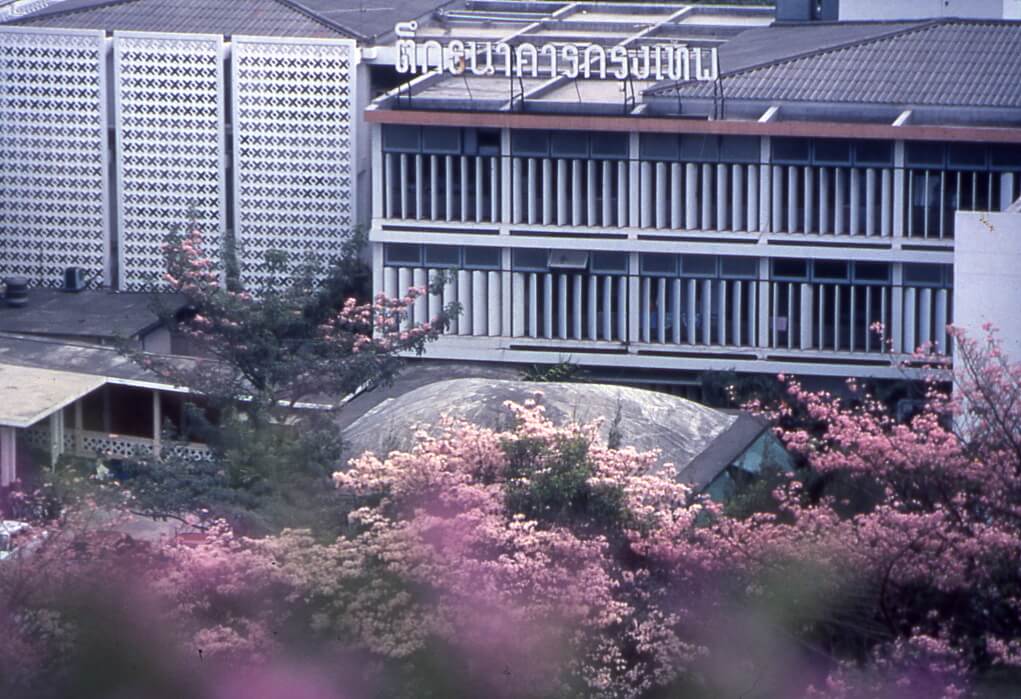
Psychiatric services began in 1959, initially providing outpatient care in conjunction with the Department of Medicine, alongside a 1–2 bed capacity for inpatients. Later in 1962, a dedicated psychiatric inpatient ward was opened on the ground floor of the Bangkok Bank Building with an 8-bed capacity, making it the first psychiatric ward within a faculty of medicine in Thailand, while outpatient services were concurrently expanded. By 1968, the inpatient capacity was increased to 14 beds, and a multidisciplinary psychiatric team was established for the first time—consisting of social workers, clinical psychologists, and psychiatric nurses—with an occupational therapist joining the team the following year, significantly broadening the scope of practice.
Subsequently, the ground floor of the Bangkok Bank Building served as the departmental office and a 14-bed inpatient ward, with spatial expansions to the Vachirunhis Building and the Old Surgery Building to accommodate faculty lounges and resident quarters, while outpatient services were relocated to the 12th floor of the Bhor Phor Ror (BPR) Building.
In early 2019, the faculty lounges (in part) and resident quarters were relocated from the Vachirunhis Building and the Old Surgery Building to the 3rd floor of the Bangkok Bank Building. On March 15, 2019, the inpatient ward was moved from the 1st floor of the Bangkok Bank Building to the Panchama Rajini Building, operating exclusively on the 1st floor with an increased capacity of 17 beds. In December 2019, the department initiated inpatient services for child and adolescent psychiatry with 3 designated beds. Later, on June 22–23, 2020, the departmental office was relocated from the Bangkok Bank Building to the 15th floor of the Rattanawittayapat Building. Most recently, on July 18, 2022, the Child and Adolescent Psychiatry Inpatient Ward was officially opened on the 2nd floor of the Panchama Rajini Building.
Subsequently, the ground floor of the Bangkok Bank Building served as the departmental office and a 14-bed inpatient ward, with spatial expansions to the Vachirunhis Building and the Old Surgery Building to accommodate faculty lounges and resident quarters, while outpatient services were relocated to the 12th floor of the Bhor Phor Ror (BPR) Building.
In early 2019, the faculty lounges (in part) and resident quarters were relocated from the Vachirunhis Building and the Old Surgery Building to the 3rd floor of the Bangkok Bank Building. On March 15, 2019, the inpatient ward was moved from the 1st floor of the Bangkok Bank Building to the Panchama Rajini Building, operating exclusively on the 1st floor with an increased capacity of 17 beds. In December 2019, the department initiated inpatient services for child and adolescent psychiatry with 3 designated beds. Later, on June 22–23, 2020, the departmental office was relocated from the Bangkok Bank Building to the 15th floor of the Rattanawittayapat Building. Most recently, on July 18, 2022, the Child and Adolescent Psychiatry Inpatient Ward was officially opened on the 2nd floor of the Panchama Rajini Building.

1959
Psychiatric services began in 1959, initially providing outpatient care in conjunction with the Department of Medicine, alongside a 1–2 bed capacity for inpatients.

1968
A dedicated psychiatric inpatient ward was opened on the ground floor of the Bangkok Bank Building.

1962
The inpatient capacity was increased to 14 beds, and a multidisciplinary psychiatric team was established for the first time.

2019
The faculty lounges (in part) and resident quarters were relocated from the Vachirunhis Building and the Old Surgery Building to the 3rd floor of the Bangkok Bank Building.
2020
The departmental office was relocated from the Bangkok Bank Building to the 15th floor of the Rattanawittayapat Building.
2022
The Child and Adolescent Psychiatry Inpatient Ward was officially opened on the 2nd floor of the Panchama Rajini Building.
Academic Affairs
In the early stages, psychiatric instruction within the Doctor of Medicine (M.D.) curriculum was conducted by guest lecturers from Somdet Chao Phraya Hospital, Department of Medical Services, Ministry of Public Health. Subsequently, in 1956, the 1st National Conference on Medical Education in Bangsaen, Chonburi, resolved that all faculties of medicine must establish permanent psychiatric faculty positions to oversee psychiatric education. Consequently, in 1957, the first psychiatric residency position was created under the Department of Medicine, and the selected physician was sent for training at Somdet Chao Phraya Hospital.
In 1959, the psychiatry curriculum was revised to increase instruction to 48 hours throughout the program. Concurrently, the World Health Organization (WHO) assigned Professor Karl M. Bowman, a distinguished WHO psychiatric expert and former Chairman of the Department of Psychiatry at the University of California, Berkeley, USA, to provide clinical supervision to university psychiatrists for one year. Senior psychiatrists from Somdet Chao Phraya Hospital also served as mentors to assist in teaching medical students and residents. Following the training of the second and third residents in 1959 and 1967 respectively, psychiatric education was partially introduced in 1959 and fully established by 1961.
The department has systematically developed its postgraduate and continuing medical education programs as follows:
In 1959, the psychiatry curriculum was revised to increase instruction to 48 hours throughout the program. Concurrently, the World Health Organization (WHO) assigned Professor Karl M. Bowman, a distinguished WHO psychiatric expert and former Chairman of the Department of Psychiatry at the University of California, Berkeley, USA, to provide clinical supervision to university psychiatrists for one year. Senior psychiatrists from Somdet Chao Phraya Hospital also served as mentors to assist in teaching medical students and residents. Following the training of the second and third residents in 1959 and 1967 respectively, psychiatric education was partially introduced in 1959 and fully established by 1961.
The department has systematically developed its postgraduate and continuing medical education programs as follows:
-
1973Initiated the Psychiatric Residency Training Program in accordance with the Thai Medical Council's specialty board certification standards, alongside the Graduate Diploma Program in Clinical Medical Sciences (Psychiatry).
-
1987Launched the Master of Science Program in Mental Health for non-medical bachelor's degree graduates to produce professionals equipped with the knowledge and skills required for community mental health promotion, prevention, and rehabilitation, as well as robust research and data analysis capabilities. The curriculum was revised in 1993, 2006, and 2011, and a part-time (special) program was introduced in 2000.
-
2001 - 20122001 – 2010Offered the Master of Science Program in Psychiatry.2002 – 2011Offered the Higher Graduate Diploma Program in Clinical Medical Sciences (General Psychiatry).2002 – 2012Offered the Higher Graduate Diploma Program in Clinical Medical Sciences (Child and Adolescent Psychiatry).
-
2009Offered the Higher Graduate Diploma Program in Clinical Medical Sciences in Psychiatry (with pathways in General Psychiatry and Child and Adolescent Psychiatry).
-
2015Launched the Graduate Diploma Program in Mental Health, featuring pathways in Cognitive Behavioral Therapy (CBT) and Addiction Sciences and Dual Diagnosis.
-
2019Launched the Fellowship Training Program in Geriatric Psychiatry, alongside the Doctor of Philosophy (Ph.D.) Program in Mental Health.
-
2021Launched the Fellowship Training Program in Consultation-Liaison Psychiatry.
-
2025Launched the Fellowship Training Program in Addiction Psychiatry.
Administration
Evolving from the Psychiatry Unit within the Department of Medicine, the unit was subsequently merged with the Neurology Unit to establish the Division of Neurology and Psychiatry in 1969, with Professor Boonliang Tamthai, M.D., serving as the Head of the Division. Later in 1973, by the resolution of the Executive Board of the Faculty of Medicine, Chulalongkorn University, the Department of Psychiatry was officially established, integrating the Child Psychiatry Unit into its structure (while the Neurology Unit returned to the Department of Medicine).
Since its inception, the Department and Division of Psychiatry has been led by successive Heads of the Department as follows:
Since its inception, the Department and Division of Psychiatry has been led by successive Heads of the Department as follows:
1973 - 1979
Associate Professor Pirom Sukhonthapirom na Phatthalung, M.D.
1979 - 1983
Associate Professor Pairoj Suthiwan, M.D.
1983 - 1991
Associate Professor Pirom Sukhonthapirom na Phatthalung, M.D.
1991 - 1995
Professor Suwatana Areephanthu, M.D.
1995 - 2003
Professor Nantika Thavichachart, M.D.
2003 - 2007
Nipat Karnjanathanalers, M.D.
2007 - 2015
Associate Professor Siriluck Supapitiporn, M.D.
2015 - 2019
Associate Professor Sukjaroen Tangwongchai, M.D.
2019 - 2023
Associate Professor Siriluck Supapitiporn, M.D.
2023 - Present
Professor Rasmon Kalayasiri, M.D.
“We are committed to advancing knowledge and innovation in psychiatry to promote mental well-being and improve the quality of life of Thai people in a sustainable way.”
Psychiatry
Chulalongkorn University